Jerash and Northern Jordan: A Complete Guide to the Green North
Everything you need to explore Jordan's green north: the Roman ruins of Jerash, Ajloun castle and pine forests, and the Decapolis hilltop of Umm Qais.
GoDiyar editorial8 min readUpdated
What is the green north of Jordan and why visit?
Northern Jordan is the country's green, hilly region, roughly an hour north of Amman, built around three landmarks: the Roman ruins of Jerash, the hilltop castle and forests of Ajloun, and the Decapolis city of Umm Qais. It is cooler, greener and more relaxed than the desert south, and it works well as a single rich day trip or a slower weekend stay.
Jerash sits about 48 km (30 miles) north of Amman, a drive of roughly an hour on the main highway. Ajloun is around 40 minutes further west through olive groves and pine woodland, and Umm Qais is up near the northern border, looking out over the Yarmouk valley. The whole loop is compact enough to combine, yet detailed enough to reward an overnight.
For families and groups from Amman and the wider region, the north is one of the easiest escapes in Jordan: short drives, mild weather most of the year, and a mix of history, forest air and home-style stays rather than big resorts.
Jerash: one of the world's best-preserved Roman cities
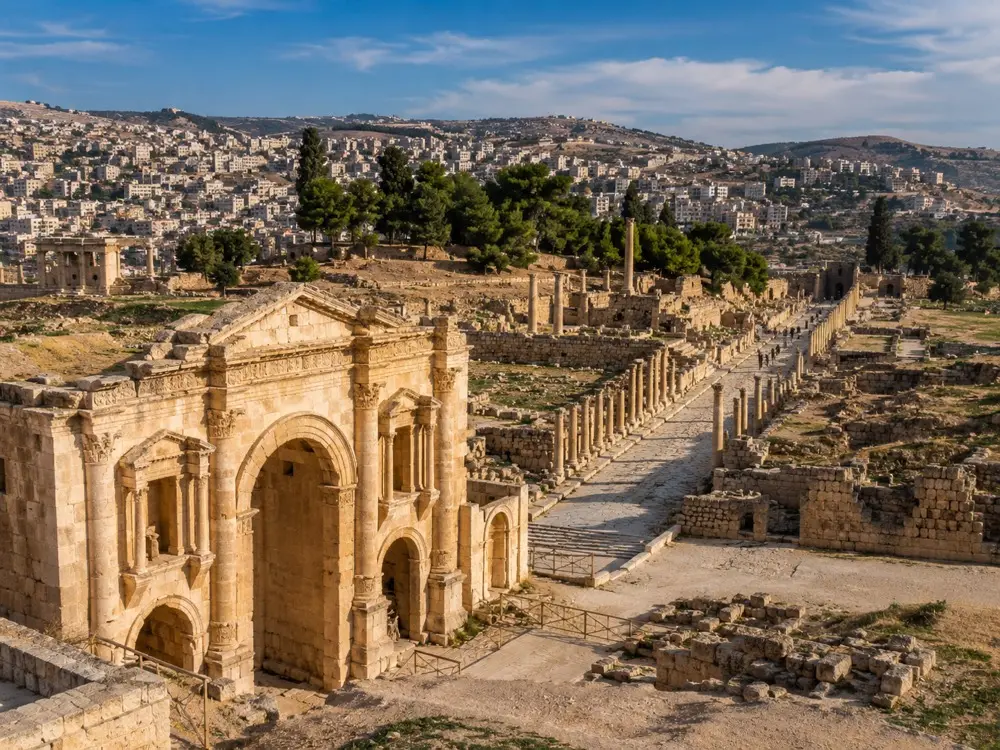
Jerash, known in antiquity as Gerasa, is widely regarded as one of the best-preserved Roman provincial towns anywhere and was one of the cities of the Decapolis. You enter through Hadrian's Arch, then walk the oval Forum ringed by columns, the long colonnaded street (the Cardo), the South Theatre, and the temples of Zeus and Artemis.
Give it at least two to three hours. The site is large and mostly open, so come with a hat, water and good shoes; early morning or late afternoon is best for light and heat. The oval plaza and the theatres, where bagpipers sometimes play, are the photo highlights, and the small on-site museum helps tie the ruins together.
Jerash is also home to the long-running Jerash Festival of Culture and Arts, usually held in summer, when the ancient theatres host music and performances. Check current dates before you plan around it, as the schedule changes year to year.
Ajloun castle and forest: the green heart of the north
Ajloun Castle (Qal'at Ar-Rabad) crowns Jabal Auf and was built in 1184-1185 by Izz al-Din Usama, a commander of Saladin, to guard the region and the routes between it. From its towers you get sweeping views over the wooded hills and the Jordan Valley, and inside there is a small museum.
The surrounding Ajloun highlands are some of the greenest in Jordan, with pine, oak and strawberry-tree forest. The Ajloun Forest Reserve, managed by the Royal Society for the Conservation of Nature, offers marked walking trails through the woodland and is a favourite for cooler-air hikes and family picnics in spring and autumn.
Ajloun is roughly 40 minutes from Jerash, so the castle pairs naturally with the ruins in one day. If you would rather slow down, the forested hills around Ajloun are exactly where a nature chalet or farm stay makes the most sense.
Umm Qais: ruins with a three-country view
Umm Qais is the site of ancient Gadara, another Decapolis city, perched on a high ridge near Jordan's northern edge. Most of its standing Roman architecture dates to around the second century AD, including a black-basalt theatre, a colonnaded street and the remains of churches, alongside a later Ottoman-era village.
The real draw is the view. From the ridge you look out over the Yarmouk River valley, the Sea of Galilee and the Golan Heights, a rare vantage where Jordan, the area around historic Palestine and Syria all meet the eye at once. Sunset here is the moment people remember.
Umm Qais sits about 110 km north of Amman, near Irbid, so it is the farthest of the three and the one most worth an overnight in the north rather than a rushed same-day return. Pair it with a slow lunch and the late-afternoon light.
Day trip from Amman or stay overnight?
If you only have one day, Jerash plus Ajloun is the classic combination: leave Amman early, spend the morning in the ruins, drive 40 minutes to the castle and forest, and return by evening. Both sit on a comfortable highway, and a single day covers the headline sights without feeling too rushed.
Add Umm Qais and you really should stay over. Trying to do all three from Amman and back in one day means a lot of driving and little time at each. An overnight in the Ajloun or Jerash hills lets you catch Umm Qais at sunset, sleep in the cool forest air, and start the next morning unhurried.
Staying over also changes the trip from sightseeing into a getaway. A chalet or farm in the hills gives you a kitchen, a terrace and quiet, which suits families and groups far better than a quick in-and-out from the capital.
Nature stays and chalets in the north
The north's strength is home-style stays in green surroundings: forest chalets, farm houses with gardens, and family villas tucked into the Ajloun and Jerash hills. These suit weekend gatherings, family reunions and groups who want a kitchen, outdoor seating and space to relax rather than a hotel room.
GoDiyar is built for exactly this local market. You can browse stays by city, see clear prices in Jordanian dinars, read reviewed and verified listings, and message hosts on the platform before you commit. Booking is request-based, so you confirm availability and details directly with the host.
For the green north, look under Jerash and Ajloun stays for chalets, farms and private-pool homes, and consider day-use venues if you want a gathering space without an overnight. If you are unsure where to base yourself, the free trip planner can suggest a north Jordan route around your dates and group size.
Practical tips for visiting the north
Best season: spring (roughly March to May) and autumn (September to November) are ideal, with green hills and mild temperatures. The north is cooler than Amman and the desert, which makes summer afternoons more bearable and winter days crisp; pack a layer for the higher ground around Ajloun and Umm Qais.
Getting around: a car gives you the most freedom to link Jerash, Ajloun and Umm Qais at your own pace. Roads between the sites are good and signposted. Start early to beat both heat and crowds at Jerash, and keep the long drive to Umm Qais for the cooler end of the day.
Bring cash for small entry points, snacks and rural shops, wear sturdy shoes for the uneven ruins and forest trails, and respect local customs in villages and reserves. With a stay booked in advance, you can relax into the trip instead of rushing back to the capital after dark.
Frequently asked
Jerash and Ajloun pair comfortably in one day from Amman, since the castle is about 40 minutes from the ruins. Adding Umm Qais, around 110 km north of Amman, is a long day and is better with an overnight in the north.
Jerash is about 48 km (30 miles) north of Amman, roughly an hour's drive on the main highway, which makes it one of the easiest day trips from the capital.
Spring (around March to May) and autumn (September to November) are best, with green hills and mild weather. The north stays cooler than Amman and the desert, so pack a light layer for higher ground around Ajloun and Umm Qais.
The north is known for home-style stays: forest chalets, farm houses, private-pool homes and family villas in the Ajloun and Jerash hills. On GoDiyar you can browse them by city with clear dinar pricing, read reviewed listings, and confirm details with the host through request-based booking.
Umm Qais is the ancient Decapolis city of Gadara, with Roman ruins on a high ridge and a rare panorama over the Yarmouk valley, the Sea of Galilee and the Golan Heights. Sunset from the ridge is the highlight many visitors remember most.